

What Are Melipona Bee Honey Eye Drops?
Melipona bee honey eye drops are a traditional ocular medicine made from the raw honey of the Melipona stingless bee, a species native to Central America that has been revered by indigenous Maya and Mesoamerican peoples for thousands of years. Unlike commercial honeybee honey, Melipona honey is produced by stingless bees in small quantities, in specific ecological conditions that cannot be replicated by commercial beekeeping, and with a biochemical profile differing significantly from what mass-produced honey carries in potency and purity.
The traditional use of Melipona honey for eye conditions is not a recent discovery. Indigenous healers across Central America have applied this honey directly to eyes for centuries to treat pterygium, conjunctivitis, cataracts, and general eye inflammation. The honey's antimicrobial and antibacterial properties allow it to penetrate deeply into the eye, purifying and healing without the harshness pharmaceutical eye drops produce in sensitive or already irritated tissue.
Four Visions' Melipona honey eye drops are 100% pristine, raw, ethical, and wildharvested Melipona honey, brought from the stingless bee colonies of Central America with the same reverence for the tradition and the ecosystem that produced this medicine.
One drop per eye is a complete session. This is not a supplement you use by the spoonful. It is concentrated, powerful, and prepared exactly as the tradition has always used it.
Why the Melipona Bee Produces a Different Medicine Than Any Other Honey
The Melipona bee is stingless, native to Central America and parts of South America, and produces honey in small quantities from a specific botanical range of Mesoamerican flowers, resins, and plant secretions that commercial European honeybee colonies do not access. The resulting honey has a high water content, enzymatic profile, and active compound density. Its pH is lower, its antimicrobial activity is broader spectrum, and its anti-inflammatory properties are more potent per unit of application than standard honey preparations.
This is why traditional Maya and Mesoamerican healers specifically developed this medicine from Melipona honey and not honey of other species. They observed the difference over generations of practice. The plant medicine intelligence they accumulated was specific: this bee, this honey, for these conditions.
The stingless bee colonies that produce genuine Melipona honey cannot be commercially. Four Visions sources it wildharvested, through direct partnerships with the communities who have maintained these colonies and this tradition, prepared raw with nothing added and nothing processed out.
One drop per eye. The stingless bee's medicine, exactly as the Maya tradition prepared it. Order Four Visions Melipona Bee Honey Eye Drops →
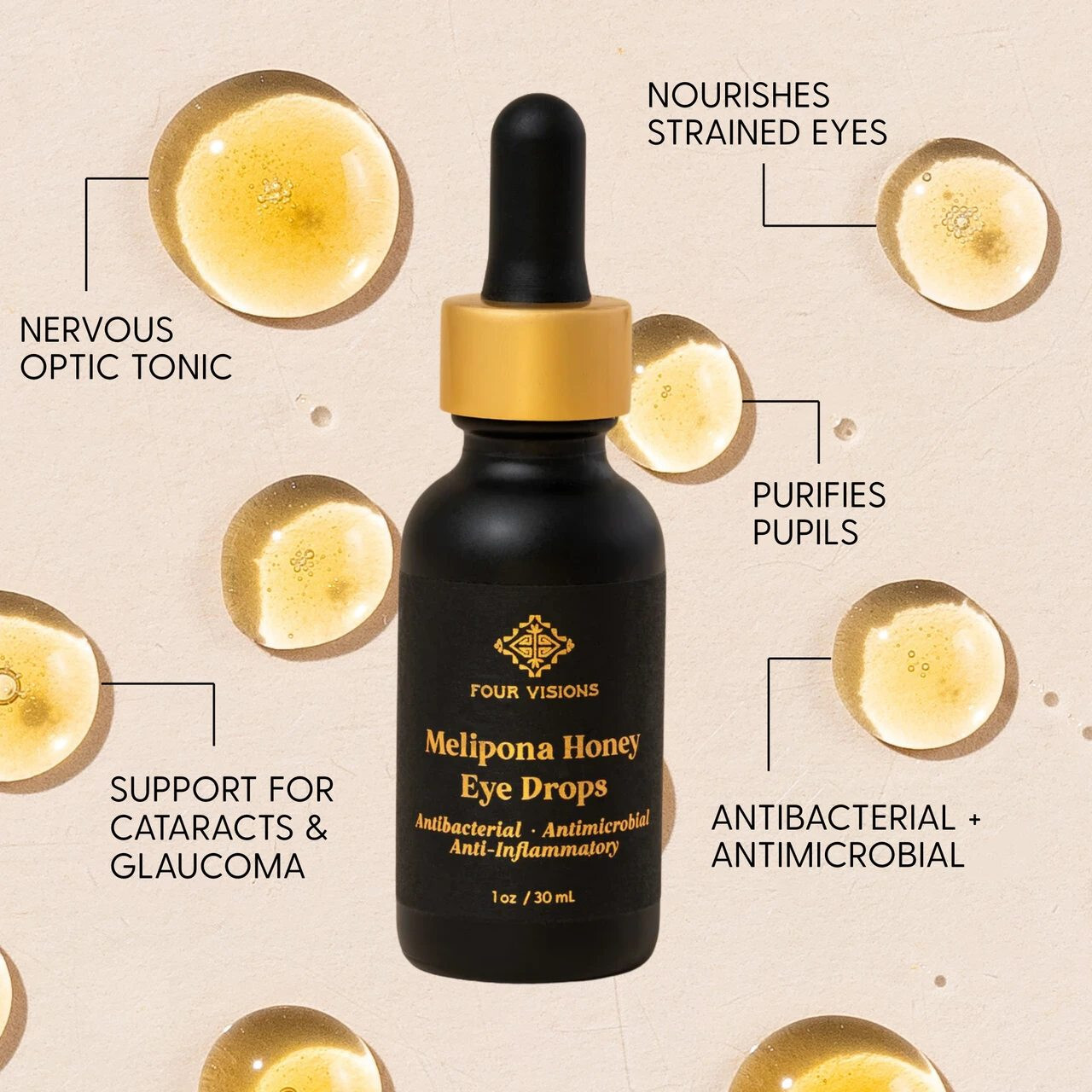
Melipona Bee Honey Eye Drop Benefits: How This Medicine Nourishes Strained Eyes
Clears Bacterial and Microbial Eye Infections Without the Side Effects of Pharmaceutical Drops
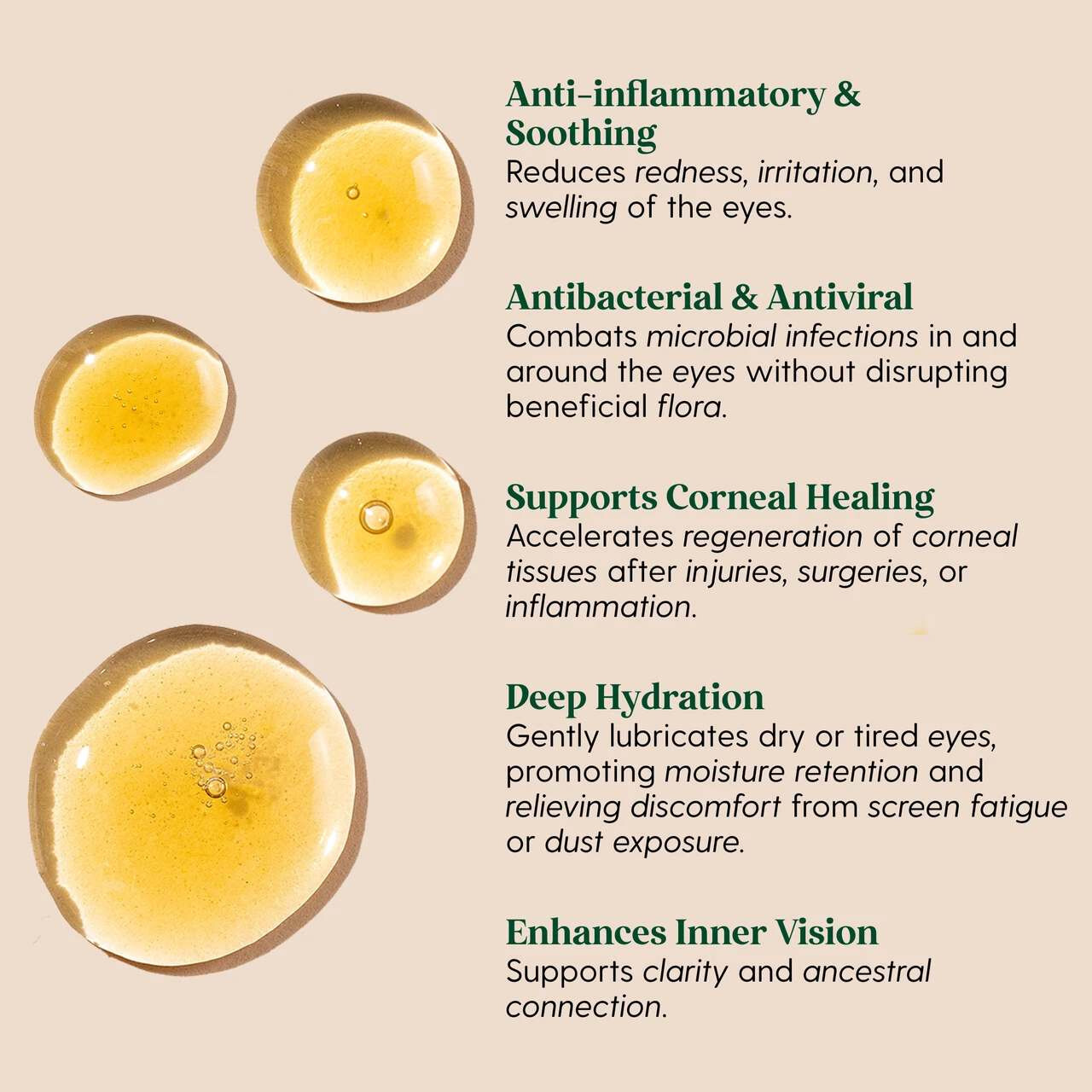
The antibacterial and antimicrobial properties of Melipona honey are its most immediately practical benefit and the reason traditional healers developed it specifically for eye conditions that resist simple washing or rest. When applied directly to the eye, the honey's active compounds penetrate the ocular tissue and address the microbial organisms driving infections like conjunctivitis at the biological source rather than simply reducing surface symptoms.
For practitioners who have experienced the burning, dryness, and rebound irritation that commercial antibiotic eye drops produce, Melipona offers antimicrobial action through a mechanism that does not carry the same risk of disrupting the eye's natural microbiome. The honey works with the eye's existing defenses rather than overriding them.
Traditional healers used this property to treat conjunctivitis specifically, applying the honey as the primary intervention for an infection that modern medicine typically addresses with synthetic antibiotics. The results they observed across generations of practice were consistent enough to establish Melipona honey eye drops as the standard of care within their tradition.
Reduces Eye Inflammation and Soothes Strained, Fatigued Eyes
Chronic eye strain from screen exposure, dry eyes, inflammatory conditions, and the cumulative fatigue of eyes forced to work in environmentally non-natural conditions than at any previous point in human history have created a population of people whose eyes are chronically inflamed, chronically dry, and chronically under-nourished.
Melipona honey's anti-inflammatory properties address this directly. A single drop applied to each eye delivers concentrated anti-inflammatory compounds directly to the tissue that needs them, reducing the inflammatory activity driving redness, irritation, and discomfort. Practitioners describe the sensation as a momentary intensity, a slight burning that passes quickly, followed by a notable softening and relief that lasts well past the initial application.
This is not a lubricating drop that provides temporary moisture relief. It is an active anti-inflammatory preparation that addresses the underlying inflammation rather than its surface expression.
Nourishes the Optic Nerve and Supports Visual Clarity
Melipona honey has been used in traditional Central American healing practice specifically as a nervous optic tonic, a medicine for the health of the optic nerve itself. This designation reflects a traditional understanding that your eye's clarity is not only a function of the eye's surface condition but of the health of the neural tissue through which visual information travels.
Practitioners who work with Melipona honey eye drops consistently describe improvements in the quality and clarity of their vision that go beyond what surface-level ocular lubrication produces. Colors appear more vivid. Visual field feels more open. The eyes that were working against chronic inflammation and fatigue begin functioning closer to their natural capacity once the inflammatory and microbial burden they were carrying is reduced.
This is the benefit that has driven the viral attention Melipona honey eye drops have received: people experiencing subjective improvements in visual clarity that they did not expect from a honey preparation, and then discovering that the traditional medicine which produced that effect has a centuries-long history that entirely accounts for the result.
May Support Healing of Cataracts, Glaucoma, and Pterygium
This is the most significant and most carefully stated claim in Melipona honey's traditional use profile. Indigenous healers of Central America have used this honey specifically for cataracts, glaucoma, and pterygium for centuries, in cases where these conditions limited vision and where conventional treatment was unavailable.
The mechanism by which honey may support these conditions relates to its antimicrobial and anti-inflammatory activity reducing the inflammatory and microbial load that accelerates progression of these conditions, alongside the nutritive and optic tonic properties that support the health of the ocular tissue involved. This is not a claim that Melipona honey cures these conditions. It is an statement of what traditional use has consistently applied it for, and what practitioners who have worked with it for serious eye conditions have observed.
Consult your ophthalmologist before using Melipona honey eye drops if you are managing any diagnosed eye condition. This product is not approved by the FDA and is not intended to diagnose, treat, cure, or prevent any disease.
Cleanses Both Physical Sight and Spiritual Perception
This is the dimension of Melipona honey eye drops that the traditional practice holds as inseparable from the physical benefits, and that the practitioners who experience it most clearly describe as the most unexpected.
The indigenous use of Melipona honey for the eyes has always been understood as addressing both physical and spiritual sight simultaneously. Clarity of vision in the physical sense and clarity of perception in the inner sense are not treated as separate categories in Mesoamerican healing tradition. The medicine that purifies the eye purifies the lens through which experience is interpreted.
Practitioners who use Melipona honey eye drops as part of a conscious healing or ceremonial practice describe a quality of perceptual openness in the hours and days following use that extends beyond what improved physical eye comfort accounts for. This is the nervous optic tonic dimension working at the level of perception rather than only at the level of tissue.
How to Use Melipona Bee Honey Eye Drops: Your Complete Protocol
Preparation: Remove contact lenses before any application. Find a calm and quiet place, either in nature or at home in a peaceful setting. Lie down. Meditative music is recommended by traditional practitioners to support the receptive state this medicine works best within.
Application: Apply one drop to the inside corner of the left eye, then immediately apply one drop to the inside corner of the right eye. The immediate sequential application balances the energies on both eyes, a practice consistent with the traditional ceremonial use of this medicine. After application, blink your eyelids gently for a short while to distribute the liquid over the whole eye. Keep eyes closed and remain lying down.
The sensation: You will feel a slight burning when the honey contacts the eye. This is normal and expected with pure raw honey applied to ocular tissue. The sensation passes within moments. Do not rinse immediately. Allow the medicine to work. After use, if needed, rinse with clean water.
Ideal timing: At night, before bed. The eyes are less exposed to light and demand during sleep, making nighttime application the most effective window for the honey's restorative and anti-inflammatory action. Before falling asleep, wash your eyes with clean water, as the honey will make the eyes slightly sticky.
With Sananga: Melipona honey eye drops work exceptionally well as a nourishing and integrating medicine after a Sananga session. Where Sananga brings intense cleansing, Melipona brings soothing restoration. The two medicines are complementary allies that many practitioners use in sequence, Sananga first, Melipona to close and integrate.
For wound and internal use: This is pure Melipona honey and can also be applied to cuts and wounds or taken internally. Melipona honey has extensive healing properties beyond the ocular application.
Storage: Store in a dark and dry place at room temperature. Do not refrigerate.
Melipona Honey Eye Drops vs. Sananga: Understanding Both Medicines
Both Melipona honey eye drops and Sananga are traditional Amazonian and Mesoamerican eye medicines used in ceremonial and healing practice. They are not competing products. They are complementary allies that address different aspects of ocular and perceptual healing.
Sananga is intense. Its application produces significant sensation and a deep, fast-acting cleansing of the physical eye and the energetic field. It is demanding medicine that requires preparation and reverence.
Melipona is powerful but soothing. It is the right choice for practitioners who are sensitive to the intensity of Sananga, who want to begin an eye medicine practice with a gentler entry point, or who want to use both medicines in sequence, with Sananga providing the deep cleanse and Melipona providing the nourishing restoration that follows.
Neither medicine is a lesser version of the other. They serve different moments in the practice.
Frequently Asked Questions About Melipona Bee Honey Eye Drops
What are Melipona bee honey eye drops? Melipona bee honey eye drops are a traditional ocular medicine made from the raw honey of the Melipona stingless bee, native to Central America. They have been used by indigenous Maya and Mesoamerican peoples for centuries to treat eye infections, inflammation, cataracts, conjunctivitis, and pterygium, and to nourish and restore vision clarity. Four Visions' preparation is 100% raw, wildharvested Melipona honey with nothing added.
Is it safe to put honey in your eyes? Raw Melipona honey has been used as an ocular medicine by traditional healers of Central America for centuries. Its antimicrobial and antibacterial properties make it specifically suited to direct eye application. A slight burning sensation upon application is normal and passes quickly. Remove contact lenses before use. Consult your healthcare provider before use if you are managing a diagnosed eye condition. This product is not approved by the FDA.
What do Melipona honey eye drops feel like? Upon application, you will feel a brief burning sensation as the honey contacts the ocular tissue. This is normal and expected with pure raw honey. The sensation passes within moments, followed by a softening and soothing relief that practitioners describe as lasting and qualitatively different from lubricating eye drops.
Can Melipona honey eye drops help with cataracts? Indigenous healers of Central America have used Melipona honey specifically for cataracts for centuries. This is a traditional use claim, not an FDA-approved medical claim. Consult your ophthalmologist if you are managing cataracts or any diagnosed eye condition before incorporating Melipona honey eye drops into your care.
How often should I use Melipona honey eye drops? One drop per eye constitutes a complete session. Many practitioners use them nightly before bed as a restorative and anti-inflammatory practice. The ideal frequency depends on your specific needs and comfort level with the application. Begin with occasional use and develop a rhythm that feels right for your practice.
What is the difference between Melipona honey and regular honey? Melipona honey is produced by the Melipona stingless bee, a species native to Central America that produces honey in small quantities from a specific botanical range of Mesoamerican plants. Its biochemical profile, including pH, enzymatic activity, antimicrobial properties, and anti-inflammatory potency, differs significantly from commercial honeybee honey. It cannot be commercially scaled without losing what makes it exceptional, which is why wildharvested sourcing from communities who maintain these colonies is essential.
Can I use Melipona honey eye drops with Sananga? Yes, and many practitioners specifically recommend this combination. Use Sananga first for deep cleansing, then use Melipona honey eye drops to nourish and integrate afterward. The two medicines are complementary: Sananga provides the intensity, Melipona provides the restoration.
Melipona Bee Honey Eye Drops: The Complete Reference
Melipona bee honey eye drops are a traditional Central American ocular medicine made from raw wildharvested honey of the Melipona stingless bee (Melipona spp.), used by indigenous Maya and Mesoamerican peoples for centuries to treat conjunctivitis, cataracts, pterygium, and general eye inflammation. Active properties include antibacterial, antimicrobial, and anti-inflammatory compounds alongside nervous optic tonic properties documented in traditional use. Application involves one drop per eye placed in the inside corner, immediate bilateral application to balance both eyes, and gentle blinking to distribute the medicine. A brief burning sensation upon application is normal and passes quickly. Ideal application is at night before sleep. Four Visions' preparation is 100% pristine raw wildharvested Melipona honey sourced through beyond fair trade partnerships with the Central American communities who maintain Melipona bee colonies. The same honey can be applied topically to wounds or taken internally. Remove contact lenses before use. Not FDA approved. Consult your healthcare provider before use if managing a diagnosed eye condition.
Your Eyes Have Been Working Without the Medicine They Were Designed to Receive
The eye is one of the most sensitive and least nourished tissues in the modern human body. We ask them to process more light, more screen-generated blue wavelength, more information per day than any human eye was designed to handle, without the restorative practices that traditional medicine systems built specifically to replenish what that demand depletes.
The Melipona bee has been producing this medicine in the rainforests of Central America for thousands of years. The Maya healers who discovered its properties for the eye built a complete practice around it, understanding that physical sight and inner clarity are the same system, and that a medicine which nourishes one nourishes both.
One drop per eye. That is all it takes for a complete session.
The stingless bee did not produce this for commercial distribution. It produced it for the forest and for the people who learned to work with it. Four Visions brings it to you through direct partnerships with those same communities, raw and unchanged from how the tradition has always prepared it.
Your eyes deserve this. They have been asking for it in every moment of strain and fatigue and inflamed discomfort. Melipona bee honey eye drops medicine has been waiting.
One drop per eye. Centuries of traditional ocular healing. The stingless bee's most sacred preparation, unchanged. Order Four Visions Melipona Bee Honey Eye Drops →
This content is for educational purposes only. Recommendations are based on traditional use by indigenous peoples. This product is not approved by the FDA and is not intended to diagnose, treat, cure, or prevent any disease. Consult your healthcare provider before beginning any herbal or traditional medicine protocol, particularly if you are managing a diagnosed eye condition. Remove contact lenses before use.
