

The Fragrance That Has Always Meant Something
There are plants that you know intellectually — you understand their properties, their uses, their tradition. And then there are plants that you know in another register entirely: through the nose, through the nervous system, through the particular quality of settling that certain fragrances produce before the rational mind has time to form an opinion.
Sweetgrass is the second kind.
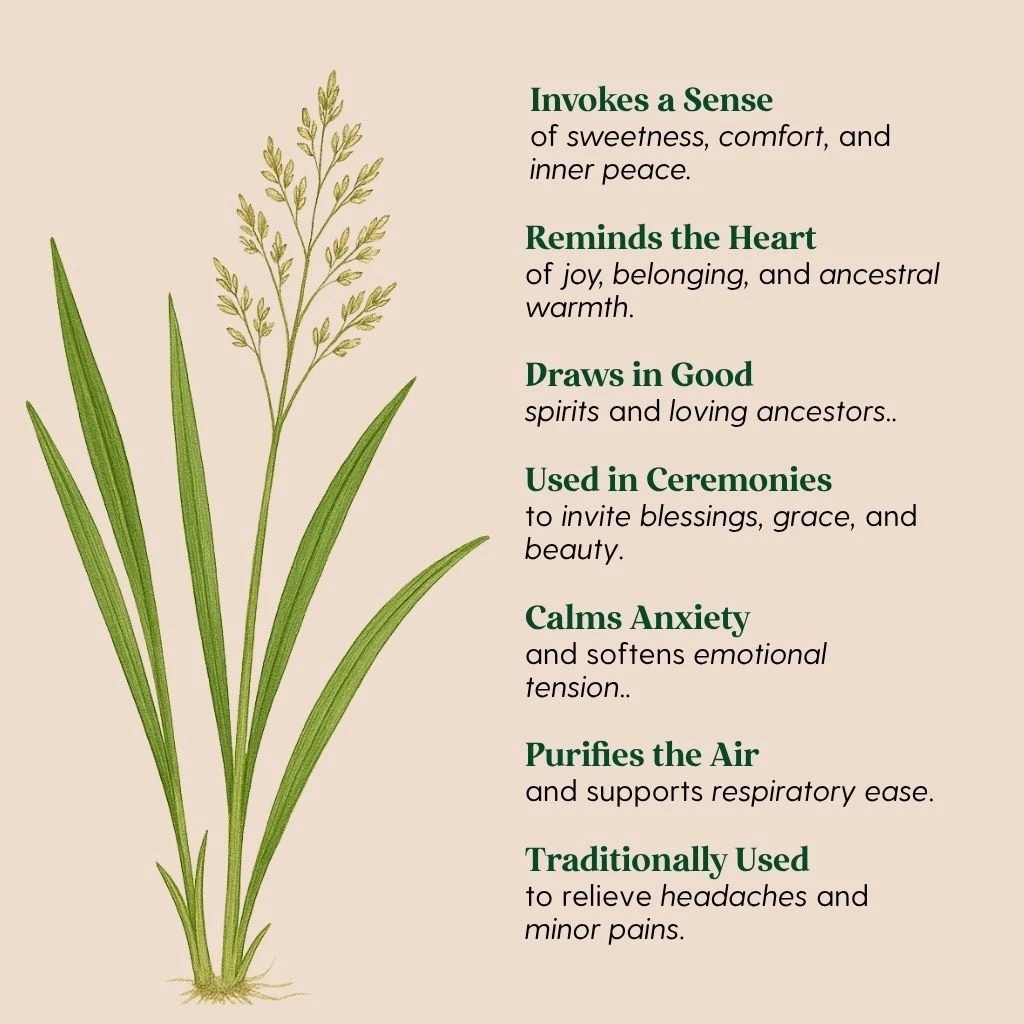
The moment you light a braid of sweetgrass and breathe the smoke, something in the nervous system recognizes it. The body exhales. The ambient vigilance that modern life has made the default setting releases — slightly and perceptibly — in the same way it releases in a forest or at the edge of moving water. This is not coincidence. The fragrance compounds in sweetgrass — coumarin chief among them — have documented effects on the nervous system, and the indigenous traditions that have worked with this plant for thousands of years understood that effect long before the biochemistry had language for it.
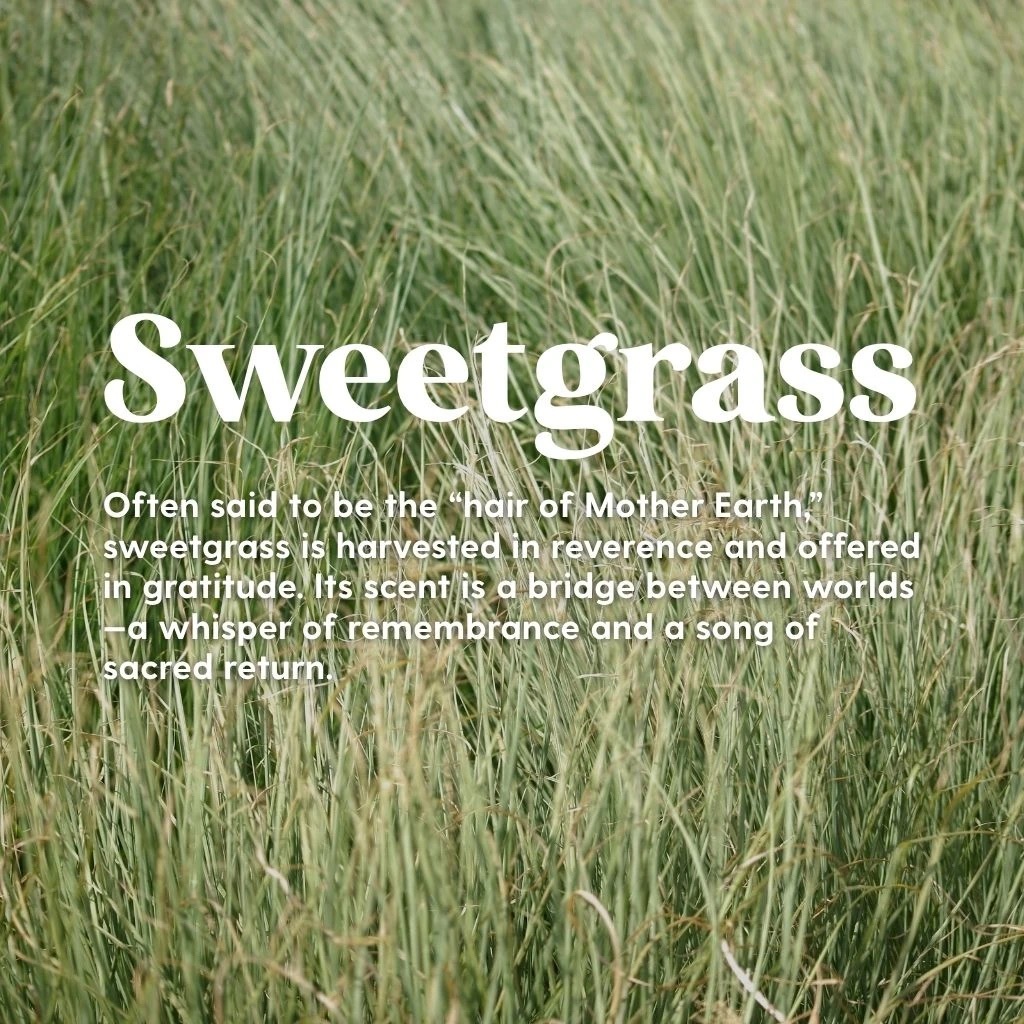
Sweetgrass (Hierochloe odorata, also known as Anthoxanthum nitens) is one of the most sacred plants in North American indigenous tradition. It is the first plant that grew on the earth in certain creation stories. It is the hair of Mother Earth in Lakota tradition. It is woven into baskets, braided and carried as an offering, burned in ceremony to invite benevolent spirits and create sacred space.
This is not a plant that simply smells good. This is a plant with a centuries-deep lineage of intentional, sacred use — and a fragrance chemistry that science is now beginning to understand in terms that confirm what indigenous practitioners always knew.
What Is Sweetgrass? The Plant Behind the Braid
Sweetgrass (Hierochloeodorata / Anthoxanthum nitens) is a perennial grass native to northern latitudes across North America, Europe, and Asia, found growing in moist meadows, along riverbanks, and at the edges of wetlands from Alaska and northern Canada south through the temperate zones. In North America, it is one of the four sacred medicines in many Anishinaabe and other Algonquin-speaking traditions — alongside tobacco, cedar, and sage — and holds significant ceremonial importance across dozens of indigenous nations including the Lakota, Ojibwe, Cree, Mi’kmaq, Haudenosaunee, and many others.
The name sweetgrass comes from its fragrance — a warm, sweet, almost vanillic scent produced by coumarin and related compounds in the plant tissue. The fragrance is most intense when the grass is dried and braided, as the braiding concentrates the aromatic compounds, and when burned, releasing them into the air as the smoke that ceremony has carried for millennia.
The traditional form is the braid — three strands of dried sweetgrass, woven together and allowed to dry into a form that can be held, gifted, hung in a home, or lit at one end and walked through a space to purify it. The three strands are understood in many traditions to represent the interweaving of mind, body, and spirit.
Sweetgrass is typically used after sage or cedar in a smudging sequence. If sage clears and purifies — removing what does not belong, cutting through the energy of conflict, illness, or negative thought — sweetgrass calls in. It invites the benevolent, the gentle, the sacred. It creates the quality of welcoming and openness that follows purification. In ceremony, the sequence matters: you clear the space first, then you invite what you want to fill it.
Responsibly harvested sweetgrass braid — the sacred grass of North American indigenous tradition.
As it has always been prepared.
Order Four Visions Sweetgrass →Sweetgrass in Indigenous Tradition: What the Traditions Say
The Anishinaabe Sacred Medicines
In the Anishinaabe (Ojibwe) tradition, sweetgrass is one of the four sacred medicines given to the people at the beginning of time, each representing a direction and a dimension of human experience. Sweetgrass represents the east — the direction of new beginnings and illumination — and is associated with the feminine, the gentle, and the opening of the heart.
The medicine wheel teaching of the four sacred plants is not primarily a pharmacological framework. It is an understanding of wholeness — the idea that complete ceremonial practice requires all four medicines working in their proper relationship. Tobacco is the foundation of prayer and offering. Cedar is for protection and strength. Sage is for purification and release. Sweetgrass is for blessing and invitation. Each has its place in the ceremonial order. None replaces the others.
Tobacco
The foundation of prayer and offering. The bridge between human intention and the sacred. The first medicine given.
Cedar
For protection and strength. The medicine of the west. Used to protect spaces and people, carried as a guardian against harm.
Sage
For purification and release. The medicine that clears what does not belong, cuts through stagnant energy, and prepares the space for what is sacred.
Sweetgrass
For blessing and invitation. The medicine of the east. What fills the space that purification has cleared. The calling in of the benevolent, the peaceful, the sacred.
The Lakota Tradition: The Hair of Mother Earth
In Lakota cosmology, sweetgrass is Wiṅyaṇ Pẖežíḡota — the sacred grass that is the hair of Uṅci Maka, Grandmother Earth. The act of braiding sweetgrass is itself a ceremony — an act of care for the earth, of honoring the relationship between human hands and the living world. Carrying a sweetgrass braid is understood as carrying the earth’s blessing in physical form.
The fragrance of sweetgrass in Lakota ceremony is understood as an invitation to benevolent and ancestral spirits. Where sage removes, sweetgrass welcomes. Where sage creates clarity, sweetgrass creates warmth. The two are often used in sequence — sometimes in the same ceremony, each doing what the other cannot.
The Mi’kmaq and Haudenosaunee Traditions
Across the northeastern woodlands, sweetgrass has been woven into baskets by Mi’kmaq, Haudenosaunee, and other nations for generations — a tradition that continues today and is both practical craft and ceremonial practice. The sweetgrass basket is not simply a container. It is a physical embodiment of the plant’s medicine, carried into everyday life through the hands of the maker and the hands of anyone who receives it as a gift.
The practice of sweetgrass basket weaving is one of the longest-standing artistic traditions in North America, with archaeological evidence of sweetgrass use in basketry extending back thousands of years. The baskets woven today by Mi’kmaq artisans carry the same fragrance, the same intentionality, and the same relationship to the plant’s sacred status that the tradition has always held.
Sweetgrass as the Plant That Always Was
In Lakota and many other traditions, sweetgrass is understood as one of the first plants to grow on the earth — present at the beginning, carrying the memory of that beginning in its fragrance and its form. This understanding is not simply mythological. It is relational: a way of saying that the relationship between human beings and this particular plant is as old as the relationship between human beings and the earth itself.
Working with sweetgrass is, in this understanding, a remembering. A return to a relationship that predates the disruptions and dislocations of modern life. The fragrance is a signal to the nervous system and the spirit both: you are home. You have always been home. This is what has always been here.
Four sacred medicines. Sweetgrass for blessing and invitation.
This is the tradition — honored exactly as it deserves to be.
Order Four Visions Sweetgrass →The Biochemistry of Sweetgrass: Why the Fragrance Works
The wisdom of the traditions that worked with sweetgrass for thousands of years does not require biochemical validation. But the biochemistry offers a bridge for those approaching this plant from a modern scientific framework — a way of understanding why what the traditions observed is consistent with what the science now describes.
Coumarin
The dominant aromatic compound in sweetgrass — the same compound responsible for the fragrance of freshly cut hay, woodruff, and tonka beans. Coumarin has documented anxiolytic effects in animal studies, reducing anxiety-related behaviors through mechanisms involving GABA receptor activity. The calming effect practitioners consistently describe from sweetgrass smoke is not placebo. The fragrance compound is doing something real in the nervous system.
Phytoncides & Aromatic Compounds
Sweetgrass smoke carries volatile organic compounds with demonstrated antimicrobial properties, consistent with the purification function that indigenous traditions assign to smoke-based cleansing practices. The science of forest bathing has demonstrated that plant-produced phytoncides produce measurable reductions in cortisol, blood pressure, and inflammatory markers. Sweetgrass operates on a related biochemical pathway.
The Olfactory-Limbic Connection
Fragrance is unique among sensory inputs: it reaches the limbic system — the emotional and memory center of the brain — more directly than any other sense, bypassing the thalamic relay that all other sensory information passes through. The emotional and physiological response to sweetgrass fragrance is not mediated primarily by the cortex or by interpretation. It is direct. This is why the smell works before you can think about whether it should.
The Traditions Did Not Need a Neuroscience Textbook.
They understood it through thousands of years of observed practice. The biochemistry simply offers a contemporary language for what the medicine has always done. Four Visions sources responsibly harvested sweetgrass through relationships that honor the plant’s sacred status and the traditions that steward it — part of over $15,000 monthly returned to indigenous partner communities and over one million dollars contributed since the company’s founding.
How to Work With Sweetgrass
Smudging and space clearing: Hold the braid at the unlit end. Light the tip and allow it to catch, then gently blow out the flame so the braid smolders and produces smoke. Walk through your space with the smoldering braid, moving the smoke into corners, doorways, and windows. Use a feather or your hand to direct the smoke. Set the intention clearly before you begin: you are inviting in the qualities of peace, blessing, and open-heartedness that sweetgrass has always been associated with. When finished, rest the braid in a fireproof vessel and allow it to extinguish naturally, or press it gently against the vessel to put it out.
After sage or cedar: The traditional sequence is purification first — sage or cedar to clear and release — followed by sweetgrass to invite in and bless. If you work with sage regularly and have never added sweetgrass to the practice, this is the most significant addition you can make to the depth of the ceremony. The clearing creates the space. The sweetgrass fills it with something worth having.
Carrying as an offering: A sweetgrass braid can be carried in a bag, kept in a vehicle, or placed in a room as a continuous gentle fragrance and blessing. Many practitioners keep a braid near their altar or meditation space, unlit, as a way of holding the plant’s presence in the space without ceremony.
As a gift: In many indigenous traditions, gifting sweetgrass is itself a ceremonial act — a way of extending blessing, protection, and good intention to someone you care for. A sweetgrass braid given with clear intention carries that intention with it.
Rehydrating for use: Dried sweetgrass braids can become brittle over time. A light misting with water and a few minutes of rest will restore flexibility before braiding or burning.
Sweetgrass: What You Need to Know Before You Order
Sweetgrass (Hierochloe odorata / Anthoxanthum nitens) is a perennial aromatic grass native to northern latitudes across North America, Europe, and Asia, and one of the most sacred plants in North American indigenous tradition. It is one of the four sacred medicines of the Anishinaabe (Ojibwe) tradition — alongside tobacco, cedar, and sage — and holds significant ceremonial importance across dozens of indigenous nations including the Lakota, Cree, Mi’kmaq, Haudenosaunee, and many others. Its characteristic sweet, vanillic fragrance is produced primarily by coumarin and related aromatic compounds, which have documented anxiolytic and calming effects through GABA receptor pathways. Traditional applications include smudging and space purification to invite benevolent spirits and create sacred space; use in ceremony following sage as a blessing and invitation after purification; gifting as a ceremonial offering; weaving into baskets as a living craft tradition; and carrying as a protective and blessing medicine. Sweetgrass is typically prepared as a braid of three strands, representing the interweaving of mind, body, and spirit. It is burned at one end to produce fragrant smoke for ceremonial use or used unlit as a continuous fragrance blessing. Four Visions sources responsibly harvested sweetgrass through relationships that honor the plant’s sacred status and the traditions that steward it. For ceremonial and educational use. Not FDA approved. Not intended to diagnose, treat, cure, or prevent any disease.
The Earth Has Always Been Offering This. The Question Is Whether You Are Ready to Receive It.
The modern world has very little ceremony left in it. The rituals that once structured daily life — the morning practice, the marking of seasons, the acknowledgment of threshold moments in a human life — have largely been replaced by routines optimized for productivity and consumption. Something is missing in this, and most people feel the absence even if they cannot name it.
Sweetgrass is one of the oldest invitations back.
It does not require initiation or training or special knowledge. It requires the willingness to slow down long enough to light a braid, to breathe the smoke, to set an intention for what you are calling into your space and your life. The practice is that simple. The depth behind it is that old.
You do not need to adopt an entire ceremonial framework to work with this plant. You need to treat it with the respect that something this old and this sacred deserves — approaching it with intention rather than decoration, with genuine curiosity rather than spiritual tourism, with the understanding that you are touching a living tradition that belongs to specific peoples and deserves to be honored as such.
Light the braid. Breathe the smoke. Let the fragrance do what it has always known how to do.
You will recognize it. You have always recognized it.
Responsibly harvested sweetgrass braid. The sacred grass of North American indigenous tradition.
For practitioners who approach this work with the respect it deserves.
Order Four Visions Sweetgrass Today →This content is for educational purposes only and is offered in respect for the North American indigenous traditions that steward the sacred use of sweetgrass. Four Visions acknowledges the Anishinaabe, Lakota, Mi’kmaq, Haudenosaunee, and all nations whose traditions are represented here. This product is not approved by the FDA and is not intended to diagnose, treat, cure, or prevent any disease. For ceremonial and educational use.
